
Attention Farm
A Scary Tale

Once upon a time, our children climbed trees. Asked endless questions. Invented games involving sticks, dirt, and highly questionable physics. They chased frogs, built forts, drew monsters on walls, and stared at clouds long enough to hallucinate entire civilizations into existence.
Now they sit six inches from glowing rectangles watching another eight-year-old scream about mystery slime.
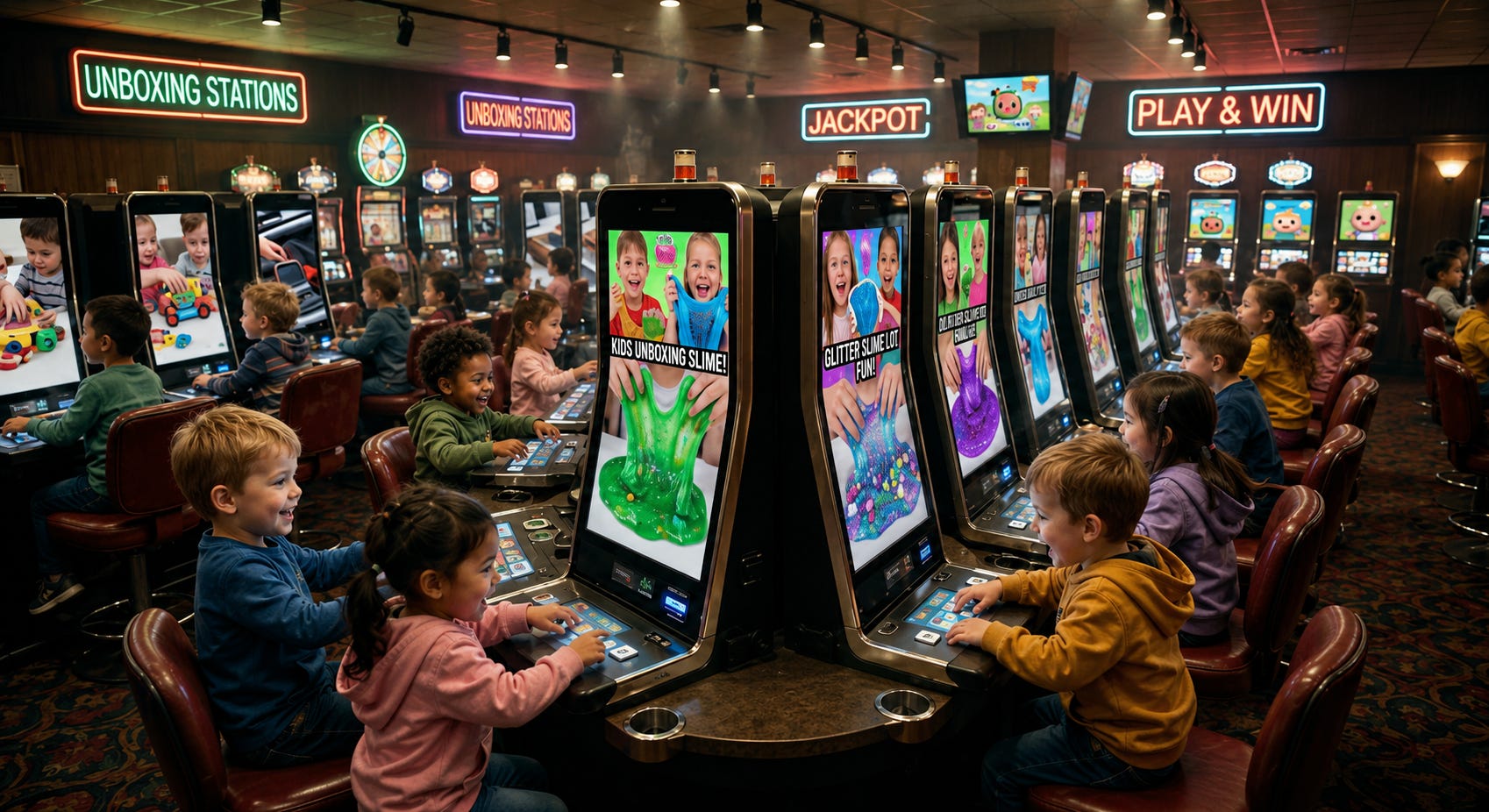
Progress. (?!).
We have somehow managed to create a civilization where the most developmentally vulnerable minds on Earth are being psychologically strip-mined by algorithms optimized somewhere between a casino slot machine and a cocaine lab monkey pressing a lever for pellets.
And we did it while calling it “content.”
The modern child entertainment ecosystem is not really entertainment anymore. It is behavioral conditioning infrastructure disguised as cartoons, challenge videos, Roblox streams, toy reveals, reaction loops, and brightly colored digital ketamine for toddlers.
The old television model at least pretended to care about stories.
There used to be beginnings, middles, and endings. Characters learned things. Actions had consequences. Villains had motives. Heroes made sacrifices. Children had to follow sequences of events longer than a fruit fly’s attention span.
Now?
A screaming British child pours glitter onto chicken nuggets while fake surprise sound effects detonate every 2.7 seconds and an algorithm whispers softly into the neural tissue of a four-year-old:
“Yes… excellent… remain seated…”
Much of modern children’s media is no longer designed around developmental enrichment.
It is designed around retention metrics.
That distinction matters more than most people understand.
Because retention engineering is not the same thing as education, imagination, or storytelling.
Retention engineering asks:
“How do we keep the organism looking at the screen for another thirty seconds?”
And after billions of dollars and data points, the answer appears to be rapid novelty, emotional exaggeration, bright colors, constant motion, fake anticipation, intermittent rewards, social mimicry, and absolutely no moment of silence long enough for a child to accidentally develop an inner world.
God forbid.
You can practically watch the nervous system surrender in real time.
The eyes glaze over like the ancient corpses staring up from the dead marshes surrounding Mordor. The mouth hangs open listlessly. The child stops wondering or exploring. Stops inventing. Stops narrating. Stops asking questions.
They just crave and absorb.
Like tiny dopamine-fed sea cucumbers illuminated by the holy glow of autoplay.
Simultaneously consuming and being consumed.
And perhaps the darkest part is that many of these videos are not actually “about” anything.
There is no narrative. No symbolism. No moral challenge. No emotional complexity. No imagination.
Just stimulus.
Infinite stimulus.
An endless conveyor belt of algorithmically refined psychic high-fructose corn syrup mainlined directly into the reward circuitry of children whose frontal lobes are still figuring out object permanence.
Meanwhile the platforms study them like lab rats.
Not metaphorically.
Literally.
Every pause. Every click. Every replay. Every second watched. Every moment of disengagement.
The machine learns what captures the child and refines itself accordingly.
Civilization has allowed Silicon Valley to conduct the largest behavioral experiment in human history on developing brains, and we handed over the test subjects willingly because the tablets kept them quiet during dinner.
Entire sectors of “kid content” now resemble a kind of digital nicotine industry for the pre-literate.
Take the unboxing phenomenon.
A child watches another child open a plastic object wrapped in layers of suspense and exaggerated emotional reaction.
What exactly is being learned here?
Not craftsmanship. Not curiosity. Not patience. Not storytelling.
Only consumption. Anticipation. Reveal. Reward.
Again.
Again.
Again.
Slot machine psychology for toddlers with juice boxes.
Then comes Roblox.
Not Roblox itself necessarily. The platform is merely the petri dish.
The real horror is the ecosystem surrounding it: screaming influencers, hyperstimulating edits, fake challenge videos, performative emotionality, engagement bait, and children watching other children pseudo-gamble for digital garbage with the emotional intensity previous civilizations reserved for surviving winter.
Just a generation ago children collected bugs.
Now they collect “skins” and fight over buckets of “rare” slime as if it were the One Ring to rule them all.
And before someone accuses this argument of becoming “anti-technology,” let us be clear:
Technology is not the issue.
A child building worlds in Minecraft, animating stories, learning music production, coding games, drawing digitally, collaborating creatively, or researching genuine interests online is engaging in something fundamentally different from passive algorithmic sedation.
The distinction is agency.
Creation versus consumption.
Exploration versus fixation.
Imagination versus extraction.
Because that is ultimately what this ecosystem increasingly resembles:
An extraction economy.
The child supplies the raw resource: attention.
The platform harvests it.
The algorithm refines it.
The advertisers purchase it.
The influencers monetize it.
And somewhere in the middle, childhood itself begins dissolving into a continuous feed supply for the Attention Farm.
An industrial-scale operation where the crop is human focus and the soil is undeveloped cognition.
The truly unsettling part is that adults are barely surviving this environment themselves.
Grown men cannot watch a movie without checking their phones every seven minutes like heroin addicts searching for emotional life support.
Adults doomscroll at red lights. While eating. While talking. While lying in bed. While supposedly relaxing.
And now we are introducing children to this machinery before many of them can even tie their shoes.
We are raising nervous systems inside environments evolution never prepared us for: infinite novelty, infinite comparison, infinite stimulation, infinite interruption.
And then acting confused when children struggle to read a book without emotionally flatlining after three pages.
The human brain adapts to the environment it repeatedly experiences.
Train a mind on fragmentation and it fragments.
Train it on anticipation loops and it craves anticipation loops.
Train it on perpetual stimulation and silence begins to feel like death.
That is why boredom matters.
Boredom is not a defect.
Boredom is the transitional state in which imagination often first appears.
It is the moment the brain says:
“Well… nothing is happening externally. Guess I’ll invent something.”
But a child who never reaches boredom because stimulation is permanently available may never fully develop the same relationship with internal creativity.
Why invent worlds when autoplay provides them endlessly?
Why explore the backyard when the algorithm already knows exactly which thumbnail will trigger the next dopamine pulse?
And perhaps most tragically, many children are no longer even being socialized primarily by families, teachers, books, or communities.
They are increasingly being socialized by engagement-maximized synthetic personalities whose primary evolutionary advantage is retaining attention.
The loudest. The fastest. The most exaggerated. The most emotionally manipulative.
Natural selection for influencers.
Not wisdom. Not depth. Not character.
Retention. Always retention.
The terrifying thing about the Attention Farm is not that it makes children stupid.
It is that it risks making them perpetually distractible, emotionally dependent on stimulation, and increasingly unable to tolerate the slow processes from which meaning, mastery, intimacy, and civilization itself are built.
Reading. Reflection. Craftsmanship. Conversation. Nature. Prayer. Love. Discipline. Thought itself.
None of these operate at TikTok speed.
And if a society loses the ability to sustain attention, it may eventually lose the ability to sustain culture itself.
An empire does not necessarily collapse because barbarians storm the gates.
Sometimes it collapses because nobody inside can focus long enough to remember why the gates existed in the first place.